
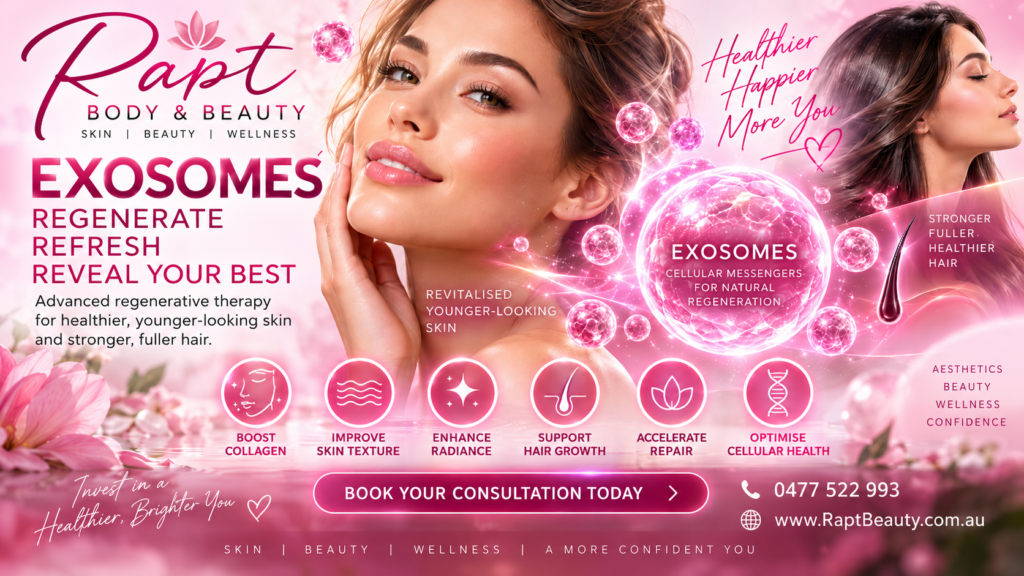
What Are Exosomes? The Complete Guide to Skin and Hair Regeneration
Exosome therapy is one of the most talked-about developments in regenerative aesthetics — but what exactly are exosomes, and what could they mean for healthier-looking skin and hair?
From supporting collagen production and skin recovery to emerging applications in hair and scalp rejuvenation, exosomes are attracting considerable interest in aesthetic medicine.
At Rapt Body & Beauty in Hamilton, Brisbane, exosome therapy is available for clients looking to explore advanced approaches to skin rejuvenation and hair restoration.
What Are Exosomes?
Exosomes are extremely small extracellular vesicles released by cells. Think of them as microscopic communication packages that can carry biologically active molecules between cells.
Their cargo can include:
- Proteins and peptides
- Lipids
- Growth-related signalling molecules
- Messenger RNA and microRNAs
- Other molecules involved in cellular communication
Rather than being stem cells themselves, exosomes are cell-derived messengers. Their ability to influence cellular signalling is why researchers are investigating them across regenerative medicine and aesthetic dermatology.
EDUCATIONAL VISUAL: How Exosomes Communicate
CELL → EXOSOME RELEASE → CELLULAR MESSAGING → REGENERATIVE RESPONSE
🔵 Healthy Cell
↓ releases
🟢 Exosome
↓ carries biological signals
🔵 Target Cell
↓ may influence
✨ Collagen production • Repair signalling • Inflammation • Tissue renewal
Why Are Exosomes Becoming Popular in Skin Rejuvenation?
Skin ageing is much more than the appearance of wrinkles.
With age and accumulated environmental exposure, the skin may experience declining collagen and elastin production, oxidative stress, slower repair processes and changes to the extracellular matrix.
This can contribute to:
- Fine lines and wrinkles
- Loss of firmness
- Uneven texture
- Dullness
- Pigmentation irregularities
- Reduced elasticity
- Slower recovery following aesthetic procedures
Exosomes are being investigated because their signalling molecules may interact with several of these biological processes.
Recent human studies and systematic reviews have reported encouraging improvements in areas including skin hydration, elasticity, texture, pigmentation, wrinkles and overall appearance, although research remains developing and treatment protocols are not yet standardised.
How Could Exosomes Support Skin Regeneration?
1. Supporting Collagen and Elastin
Collagen provides much of the skin’s structural strength, while elastin helps skin maintain flexibility and resilience.
Exosome-based preparations are being investigated for their potential to influence fibroblasts — cells responsible for producing important components of the extracellular matrix.
The goal is not simply to temporarily hydrate the surface of the skin, but to support biological processes involved in healthier-looking skin.
2. Supporting Skin Recovery
Exosome signalling has also attracted attention for its potential role in tissue repair and wound-healing pathways.
This is particularly interesting in aesthetic medicine because controlled treatments such as microneedling deliberately create microscopic channels or controlled injury to stimulate a healing response.
3. Helping Improve Skin Texture
By supporting regenerative signalling and extracellular-matrix activity, exosome treatments are being investigated for concerns such as rough texture, fine lines and signs of photodamage.
4. Supporting a More Even-Looking Complexion
Early research also suggests potential effects on pathways involved in pigmentation and inflammation, which may help explain why some studies report improvements in overall skin tone and appearance.
EDUCATIONAL INFOGRAPHIC: Exosomes + Skin
EXOSOME SIGNALLING
↓
🧬 Cellular communication
↓
🟢 Fibroblast activity
↓
✨ Collagen & extracellular matrix support
↓
💧 Skin hydration & recovery
↓
🌟 Smoother, firmer, healthier-looking skin
The important point: exosomes are not simply another moisturising ingredient. Their appeal comes from their potential role as biological signalling particles.
Exosomes and Microneedling: Why Are They Often Combined?
One increasingly discussed approach in regenerative aesthetics is combining an exosome preparation with microneedling.
Microneedling creates controlled microchannels in the skin while simultaneously triggering the body’s natural wound-healing response.
Exosome-containing products may then be applied as part of an appropriately selected treatment protocol.
Conceptually, this creates a complementary approach:
Microneedling creates the regenerative stimulus.
Exosome signalling may support the subsequent recovery environment.
The combination is being investigated for concerns including:
- Fine lines
- Uneven texture
- Loss of firmness
- Dull or tired-looking skin
- Enlarged-looking pores
- Acne-related textural irregularities
- General skin rejuvenation
Treatment suitability varies, and not every skin condition should be treated in the same way.
EDUCATIONAL VISUAL: Microneedling + Exosome Concept
STEP 1
MICRONEEDLING
Controlled microchannels stimulate the skin’s natural repair response.
⬇️
STEP 2
EXOSOME APPLICATION
Bioactive signalling particles are introduced as part of the treatment protocol.
⬇️
STEP 3
CELLULAR COMMUNICATION
Signals interact with cells involved in repair and extracellular matrix activity.
⬇️
STEP 4
REMODELLING
Collagen, skin recovery and renewal processes continue over time.
⬇️
RESULT
✨ Smoother-looking texture
✨ Improved radiance
✨ Firmer-looking skin
✨ Healthier overall complexion
What About Exosomes for Hair Regeneration?
This is another particularly exciting area of research.
Hair follicles are complex miniature organs that continually transition through phases of growth, regression and rest.
In common forms of progressive hair thinning, including androgenetic alopecia, the normal hair cycle becomes disrupted and follicles may gradually miniaturise.
Researchers are studying whether exosome signalling can influence cells around the follicle, including dermal papilla cells, which have an important role in regulating hair growth.
Potential mechanisms being investigated include effects on:
- Dermal papilla cell activity
- Follicular regeneration
- Angiogenesis and blood-vessel signalling
- Inflammatory pathways
- Wnt/β-catenin signalling
- The transition of follicles toward the active growth phase
Early human studies have reported improvements in hair density and/or hair shaft thickness in some participants. However, the evidence remains heterogeneous, with different exosome sources, concentrations, delivery techniques and treatment schedules being studied.
EDUCATIONAL INFOGRAPHIC: Exosomes and the Hair Follicle
EXOSOME SIGNALLING
🟢🟢🟢
⬇️
SCALP + HAIR FOLLICLE
⬇️
Potential biological targets:
🧬 Wnt/β-catenin signalling
Supports pathways associated with follicular growth
🩸 VEGF signalling
Associated with vascular support around follicles
🌱 Dermal papilla cells
Important regulators of the hair-growth cycle
🔥 Inflammatory signalling
May influence the follicular environment
⬇️
POTENTIAL HAIR OUTCOMES
Improved scalp environment → follicular support → thicker/denser-looking hair
Who Might Consider Exosome Hair Therapy?
Exosome-based scalp treatments may be discussed with people experiencing concerns such as:
- Early-stage hair thinning
- Male or female pattern hair loss
- Reduced hair density
- Increasingly fine or miniaturised hair
- General scalp and follicular rejuvenation
However, hair loss should not automatically be treated as a cosmetic problem.
Hair shedding can have many causes, including iron deficiency, thyroid disorders, nutritional deficiencies, hormonal changes, medications, autoimmune disease, stress and various forms of alopecia.
Identifying the cause is important before deciding on the most appropriate treatment.
When Will I See Results?
Regenerative treatments generally aren’t about overnight transformation.
Skin improvements following regenerative aesthetic procedures may develop progressively as recovery and remodelling occur.
Hair takes even longer.
Because hair follicles operate through biological growth cycles, changes in density or thickness may take several months to become noticeable.
The number and frequency of treatments required can also vary depending on the treatment area, underlying concern and individual response.
Are Exosomes the Same as Stem Cells?
No.
This is an important distinction.
Stem cells are living cells capable of self-renewal and differentiation.
Exosomes are tiny extracellular vesicles released by cells. They function primarily as biological messengers, carrying molecular signals from one cell to another.
STEM CELLS vs EXOSOMES
| Stem Cells | Exosomes |
|---|---|
| Living cells | Extracellular vesicles |
| Can divide | Cannot reproduce |
| Contain cellular structures | Carry molecular cargo |
| Can differentiate | Primarily involved in signalling |
| Cell-based therapy | Cell-free signalling approach |
This distinction is one reason exosomes have generated considerable interest in regenerative research.
Are All Exosome Products the Same?
Definitely not.
This is one of the most important issues in this rapidly developing field.
Exosome preparations can differ considerably according to their biological source, manufacturing methods, purification, concentration, characterisation, storage conditions and delivery method.
This means the word “exosome” on its own does not guarantee that two products are equivalent.
Quality, sourcing, sterility, appropriate handling and professional treatment protocols matter.
Research reviews have specifically identified product heterogeneity and lack of standardised manufacturing and treatment protocols as important challenges facing the field.
What Does the Scientific Evidence Say?
The evidence surrounding aesthetic exosome treatments is encouraging, but it is important to keep it in perspective.
Recent systematic reviews of human studies have found improvements across several skin outcomes, including wrinkles, hydration, elasticity, pigmentation and texture.
Research into hair restoration has similarly reported improvements in hair density and shaft thickness in some clinical studies.
However, researchers continue to highlight limitations including:
- Small study populations
- Different exosome sources
- Different concentrations
- Variable delivery techniques
- Short follow-up periods
- Lack of standardised treatment protocols
- Limited large-scale randomised controlled trials
Therefore, exosome therapy should currently be viewed as an emerging regenerative aesthetic technology, rather than a guaranteed cure for ageing skin or hair loss.
Exosome Therapy at Rapt Body & Beauty, Hamilton Brisbane
For clients interested in exploring regenerative skin or hair treatments, Exosome Therapy is available at Rapt Body & Beauty in Hamilton, Brisbane.
Treatment options can be discussed according to your individual concerns, whether your goal is to improve the appearance of ageing or damaged skin, support skin recovery or explore options for thinning hair and scalp rejuvenation.
A consultation is particularly important because the best treatment approach depends on your skin, scalp, medical history and the underlying cause of your concern.
Ready to Discover Regenerative Skin & Hair Treatments?
If you’re curious about whether exosome therapy could complement your skin or hair rejuvenation plan, book a consultation with Rapt Body & Beauty in Hamilton, Brisbane.
Rapt Body & Beauty
Hamilton, Brisbane QLD
📞 0477 522 993
🌐 www.RaptBeauty.com.au
Book a consultation and discover a personalised approach to healthier-looking skin and hair.
This article is provided for general educational purposes and should not be interpreted as medical advice. Exosome-based aesthetic treatments remain an evolving field, and individual results cannot be guaranteed. Treatment suitability, risks, expected outcomes and alternatives should be discussed with an appropriately qualified healthcare professional.